|
| ||||
"I hated the job at first -- all that getting up early and eating soup in a paper cup for lunch. But now I don't mind." -- Joan Bennett in 1968, about her stint on Dark Shadows.
| Joan Bennett Appeared in: 385 episodes First episode: #1, June 27, 1966 Last episode: #1245, April 2, 1971 Biography: Joan was born into an acting family -- with theatrical roots dating back to the 1700s. Although at first she was shy, and at times felt overshadowed by her glamorous older sister, Constance Bennett, Joan did gravitate toward the stage, making her debut a age 4 in one of her father's plays. The next year, 1916, she appeared in her first film, The Valley of Decision, with both of her parents (Richard Bennett and Adrienne Morrison). As a proper young socialite-in-training, Joan attended a boarding school in Connecticut and a finishing school in France. Her formal education ended abruptly, however, when at 16 she married John Marion Fox. By 17, she had a daughter; by 18, she was divorced. The young mother turned to acting to support herself and found enormous success. Her first starring role was in Bulldog Drummond with Ronald Coleman in 1929. For the next twenty-one years, she was a favorite of critics and audiences, making over 50 more films, including Little Women (1933), Fritz Lang's Scarlett Street (1945), and Father of the Bride (1950). (Along the way, she was married and divorced again; she and writer/producer Gene Markey were married from 1932 to '38.) In the early years of her movie career, Joan was a bleach-blonde, because publicists and producers wanted her to resemble her movie star sister, Constance. But in for the film Trade Winds (1938), producer Walter Wanger (later her husband), put her in a brunette wig and transformed her career. The new dark-haired look (which she kept the rest of her life) helped her evolve into a femme fatale. "The minute I turned brunette, the parts I got were so much better," she later told a reporter. Joan was among the army of young actresses competing for the plum part of Scarlett O'Hara in 1939's Gone With the Wind-and was reportedly Vivian Leigh's first runner-up. Even though she didn't get that coveted role, she was a busy, successful actress. But a gunshot brought a screeching halt to Joan's movie stardom in 1951. While she and her agent, Jennings Lang, sat in a parked car in Los Angeles, Joan's husband, Walter Wanger, showed up with a pistol, accused Lang of being a home-wrecker, and shot him in the groin. The agent, who denied any hanky panky with his client, recovered, and Wanger served 100 days at a minimum-security prison. But the Wanger/Bennett marriage was over, and for a while it seemed her career would end as well. Though the shooting seems fairly tame by today's standards, in the conservative 1950s environment, it was one of the most scandalous episodes to hit Hollywood. In a 1981 interview, she looked back with a sense of humor. "It would never happen that way today," she said laughing. "If it happened today, I'd be a sensation. I'd be wanted by all studios for all pictures." With no movie offers, she returned to her first love, the stage, in such productions as a touring company of Bell ,Book and Candle. She also began appearing on television.
The job grew on Joan. "I hated the job at first," she admitted to the Saturday Evening Post in 1968. "All that getting up early and eating soup in a paper cup for lunch. But now I don't mind. After all, poor Jonathan does most of the work. Isn't that amazing about him? Some of it has rubbed off on all of us. A month ago I was in the Midwest, narrating a fashion show and the teeny-boppers just inundated me. I felt positively like a Beatle." While Dark Shadows was on the air, Joan, then a grandmother, was the subject of countless magazine articles, and she was even featured on bubble gum cards and a View-Master set. She was an in-demand talk show guest, and fan mail poured in for her. After the show left the air, she made a few TV appearances, and one final film: Suspiria, a 1977 gory horror movie. At age 65, she made no secret of the fact she was living unmarried with former newspaper publisher David Wilde. For a magazine article in 1975, she discussed her domestic situation. "I just wouldn't want to take a chance of breaking up a beautiful relationship," said the thrice-married Bennett. "I think marriage is fine if you want to have children. I wouldn't dream of having a child if I were not married, and I don't approve of young people doing that today. But I think when you reach my age, it is stupid." Stupid or not, three years later the couple did tie the knot and remained married until Joan's 1990 death. Though she was quite frail in her later years, Joan attended several Dark Shadows Festivals, greeting fans and signing autographs. She died December 7, 1990 of a heart attack. Career Highlights: Daytime TV: • Guiding Light (herself, 1983) • Over Easy (1982) • Movie Game (1971) • Girl Talk (1970)
• Dick Cavett Show • Joan Rivers Show • What's My Line • Match Game • Dating Game • Hollywood Squares PRIMETIME TV: • A Tribute by Katharine Hepburn: The Spencer Tracy Legend (1986), George Cukor Tribute (1985), Love American Style, Joe Franklin Show, Merv Griffin Show, The Governor and J.J. (1970), Burke's Law (1965), Mr. Broadway (1964), Too Young to Go Steady (Mary Blake, 1959), Pursuit: Epitaph for a Golden Girl, Playhouse 1990 (1957), Teller of Tales, Nash Airflyte Theatre, Junior Miss (Grace Graves, 1957, pilot), The Best of Broadway: The Man Who Came to Dinner (Lorraine Sheldon, 1954), Ford Television Theatre, Danger, NBC's Show of Shows (1951). TV FILMS: Divorce Wars: A Love Story (Adele Burgess, 1982), This House Possessed (Rag Lady, 1981), Suddenly Love (Mrs. Graham, 1978), Gidget Gets Married (Claire Ramsey, 1972), The Eyes of Charles Sand (Aunt Alexandra, 1972). TV COMMERCIAL: Geritol. SCREEN: Suspiria (1976), House of Dark Shadows (Elizabeth Collins Stoddard, 1970), Desire in the Dust (1960), There's Always Tomorrow (1956), Navy Wife (1956), We're No Angels, (1955), Highway Dragnet (1954), The Guy Who Came Back (1951), Father's Little Dividend (1951), For Heaven's Sake (1950), Father of the Bride (1950), The Reckless Moment (1949), Hollow Triumph, aka The Scar (1948), Secret Beyond the Door (1948), The Woman on the Beach (1947), The Macomber Affair (1947), Colonel Effington's Raid (1946), Scarlet Street (1946), Nob Hill (1945), The Woman in the Window (1944), Margin for Error (1943), Girl Trouble (1942), The Wife Takes a Flyer (1942), Twin Beds (1942), Confirm or Deny (1941), Wild Geese Calling (1941), Man Hunt (1941), The Man I Married (1940), The House Across the Bay (1940), Green Hell (1940), Son of Monte Cristo (1940), The Housekeeper's Daughter (1939), The Man in the Iron Mask (1939), Trade Winds (1938), Artists and Models Abroad (1938), The Texans (1938), I Met My Love Again (1938), Vogues of 38 (1937), Wedding Present (1936), Two in a Crowd (1936), Big Brown Eyes (1936), Thirteen Hours by Hour (1936), The Man Who Broke the Bank at Monte Carlo (1935), She Couldn't Take It (1935), Two for Tonight (1935), Mississippi (1935), Private Worlds (1935), The Man Who Reclaimed His Head (1934), The Pursuit of Happiness (1934), Little Women (1933), Arizona to Broadway (1933), Me and My Gal (1932), Wild Girl (1932), Weekends Only (1932), The Trial of Vivienne Ware (1932), Careless Lady (1932), She Wanted a Millionaire (1932), Hush Money (1931), Many a Slip (1931), Doctors' Wives (1931), Scotland Yard (1930), Maybe It's Love, aka Eleven Men and A Girl (1930), Moby Dick (1930), Crazy That Way (1930), Puttin' on the Ritz (1930), The Mississippi Gambler (1929), Disraeli (1929), Three Live Ghosts (1929), Bulldog Drummond (1929), Power (1928), The Eternal City (1923), The Valley of Decision (1915). THEATER: The Boy Friend (Madame DuBonnett, 1971), Once More with Feeling, The Anniversary Waltz, Never Too Late (London), The Man Who Came to Dinner (1968), Jane (1968), Fallen Angels (1968), Barefoot in the Park (1967, 1973, 1976), The Gazebo (1959-60), Anniversary Waltz (1956-57), Best Foot Foward (1953-54). BROADWAY: The Reluctant Debutante, Never Too Late (1959, 1963, 1965, 1975), Love Me Little (1958), The Pirate (1929), Jarnegan (1928). TOUR: Butterflies are Free (1973, 1979, 1980), Barefoot in the Park, The Pleasure of His Company (1957), Janus (1957), Bell, Book, and Candle (1953, 1956), Stage Door (Terry, 38). MISC: Author of book: How to Be Attractive (1941), co-author of The Bennett Playbill (1970). Consulting Editor, Girl Talk Magazine column "Equal Time" (1968-70). Produced women's apparel line, "Forever Young," for Puritan Dress Manafacturers. Portions of her 1939 Scarlett O'Hara screen test for Gone With the Wind appears in the 1988 TNT/MGM documentary: Gone with the Wind: The Making of a Legend.
The contents of this Web site are copyrighted by Craig Hamrick © 2004 | |||
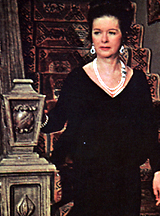

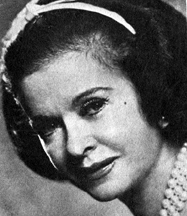 In 1966, she joined the cast of Dark Shadows. To her surprise, it made her incredibly popular again.
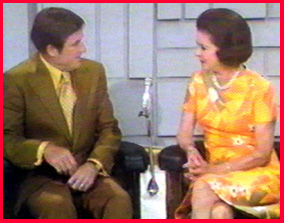 • Mike Douglas Show (picured)
Visit the rest of Dark Shadows Online | |||
|
TV Series Cast Collectibles Books by Craig Hamrick Movies Links
|